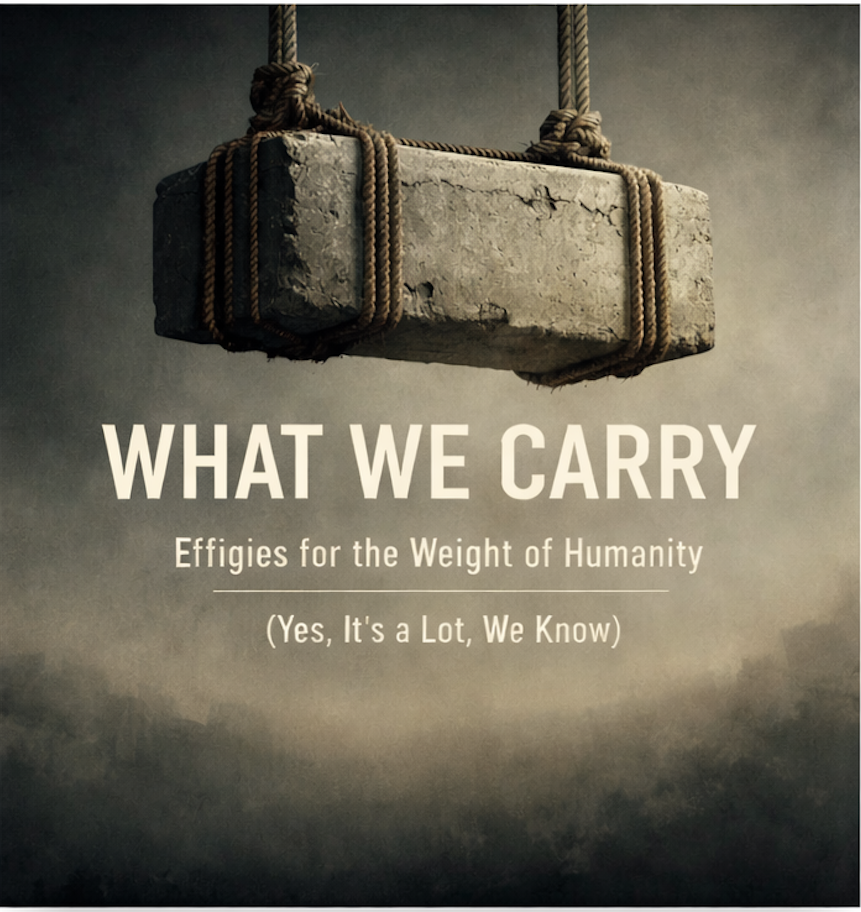
WHAT WE CARRY: Effigies for the Weight of Humanity (Yes, It’s a Lot, We Know) explores the invisible weight people carry through the world: identity, performance, expectation, and survival.
Through Dispatches and sculptural effigies, the exhibition examines the roles we inhabit and the tension between spectacle and substance.
THE EXHIBITION
Some pressure is structural.
Some pressure is procedural.
Some pressure is constant.
Some pressure is carried across borders.
THE EFFIGY COLLECTION
The sculptural effigies are currently in development.
Documentation of the completed figures will appear here as the exhibition evolves.
This effigy carries the quiet weight of systems, forms, policies, and language that accumulate without asking permission. It is dense, rigid, and deliberately inexpressive.
Living with this figure acknowledges that not all harm is loud and not all responsibility is personal. Let it hold the weight of process, procedure, and institutional fatigue so the body no longer has to.
What it carries: process without clarity, administrative overload, and the weight of procedure.
Effigy in Development
This figure holds the weight of exaggerated authority, spectacle, and inflated importance. It is intentionally overstuffed, slightly unstable, and more fragile than it first appears.
Living with this effigy is an invitation to reduce power to scale, to remember that what feels overwhelming is often padded by illusion. You do not need to confront it. Let it sit nearby and remind you that authority weakens the moment it is no longer carried intentionally.
What it carries: excess authority, public spectacle, and emotional inflation.
Effigy in Development
This effigy carries waiting, movement, and consequence. It is quieter than the others and heavier than expected.
Living with this figure is not about resolution or comfort; it is about presence. This effigy exists so dignity is not lost to abstraction. Let it remind us that witnessing is an act of care, and that shared weight is lighter than silent weight.
What it carries: waiting without a timeline, movement without arrival, identity without recognition, and hope under pressure.
Effigy in Development
This figure holds urgency, repetition, and the constant demand to react. Its interior is noisy, unsettled, and uneven, echoing the rhythm of information overload.
Living with this effigy offers an alternative to constant vigilance. When the world feels too loud, let this figure carry the headlines. You are allowed to step out of the cycle without looking away.
What it carries: information overload, anxiety cycles, and constant urgency.
Effigy in Development
DISPATCHES FROM THE EXHIBITION
When spectacle replaces substance, the performance begins to reveal itself.
SPECTACLE / SUBSTANCE
A culture begins to lose itself when the
performance becomes more important
than meaning.
We once understood the difference.
There was a time when spectacle required mastery,
when the extraordinary demanded discipline, risk, and devotion to craft.
The circus understood this.
“Ladies and gentlemen, children of all ages.”
The Ringmaster did not dominate the stage. He held it together,
organizing chaos, so something remarkable could occur within it.
The tightrope walker trained for years.
The sword swallower risked the body.
The trapeze artist trusted the fall.
Even the clown understood timing.
Spectacle had structure. Structure
allowed substance. Then something shifted.
The performance remained, the lights,
the stage, the applause, but the
meaning thinned.
Authority stopped guiding and began
controlling. Admiration turned into display.
Illusion grew stronger than truth.
The roles reversed.
The Ringmaster became the tyrant.
The performers forgot why they stepped
onto the stage. The audience could no
longer distinguish between talent and noise.
“When a clown moves into a palace, he
doesn’t become a king. The palace becomes
a circus.”
So the question remains:
How did we confuse spectacle for substance?